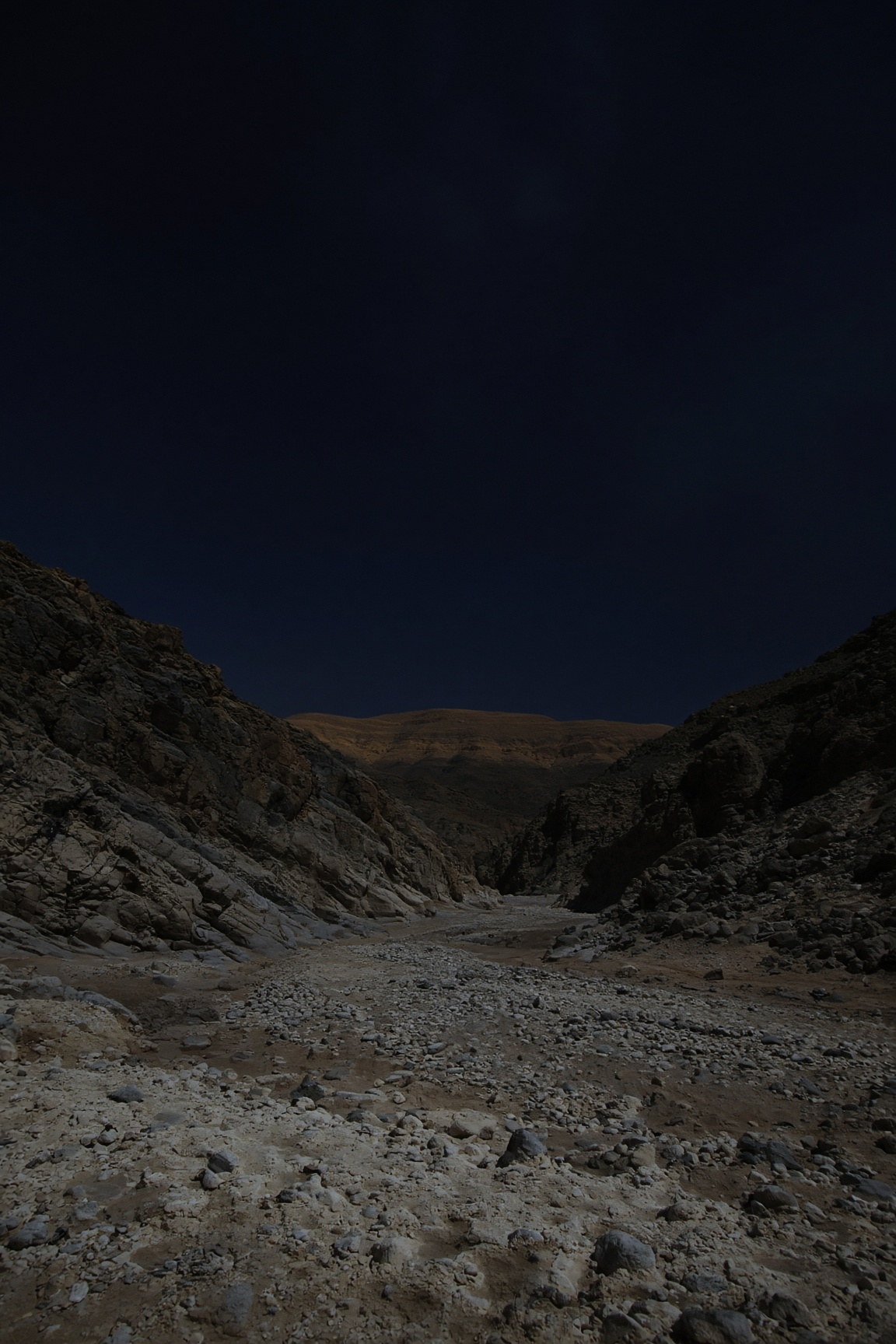
Horeb to Kadesh
Eleven days. Then a generation.
Deuteronomy opens by measuring a road. The speech that follows is made in the fortieth year.
This is not a man’s return to a house. It is a people between a leaving and a land they have not yet possessed. Egypt is the known world. It is not Ithaca. Canaan is promised. It is not remembered.
Deuteronomy 1.2–3
How long was the road?
It is eleven days from Horeb to Kadesh-barnea by the Mount Seir road.
The eleven days are a route measure, not a stopwatch of the whole exodus. Horeb is Sinai in Deuteronomic diction. Kadesh-barnea is the southern approach to the land, often identified with the oasis at Ein el-Qudeirat; that identification is traditional and argued, not certain. Mount Seir names the hill country of Edom, a way, not a single pass.
The same opening then dates Moses’ speech: the fortieth year, the eleventh month, the first day. Geography and calendar are set beside each other without a sermon in between. The reader is meant to feel the gap.
Horeb / Sinai·proposed
The mountain of the covenant. Location unagreed: traditional Jebel Musa, and other proposals in Sinai and northwest Arabia.
Kadesh-barnea·traditional
Often placed at Ein el-Qudeirat in northern Sinai. The biblical toponym and the archaeology are not the same kind of proof.
Mount Seir·traditional
Edomite highlands. The ‘way of Mount Seir’ is an itinerary clause, not a surveyed path.
Narrative time
What the books actually count
Forty years is not forty years of walking. The Hebrew narrative is an itinerary with long camps, not a forced march.
01
ProposedLeaving Egypt
The departure is told in Exodus 12–14. Yam Suf, the sea of reeds, is the first threshold. Historicity of a mass Late Bronze exodus is contested in scholarship. The story as story still has a leaving.
02
ProposedThe mountain
Exodus 19.1 places arrival at Sinai in the third month after leaving Egypt. Numbers 10.11 dates the departure from the mountain to the second month of the second year. About a year is spent at the mountain, receiving law, not covering ground.
03
TraditionalHoreb to Kadesh
Deuteronomy 1.2: eleven days by the Seir road. This is the short road. It is the measure that makes the later time a problem rather than a terrain feature.
04
TraditionalForty days of seeing
Numbers 13.25: the scouts reconnoitre the land for forty days. They bring fruit, and a report of a good land, and of people who seem stronger than Israel. Caleb, and in the combined account Joshua, dissent.
05
Mythic / unlocatableA year for a day
Numbers 14.33–34: the children will herd in the wilderness forty years, a year for each day of the reconnaissance, until the last carcass of the refusing generation is down. This is Priestly arithmetic. It is a sentence, not a map scale.
06
TraditionalForty-two named camps
Numbers 33 lists the stages from Rameses to the plains of Moab. The list is counted as forty-two stations. Moses writes the starting-points, stage by stage, by command of YHWH (33.2), as the second generation stands ready to cross. The list is a memorial itinerary, not a hiking diary: about eighteen of the names appear only here. It is not the eleven-day route, and it is not the forty years. Do not promote the count into a key that opens every other road.
07
TraditionalThirty-eight years after Kadesh
Deuteronomy 2.14: thirty-eight years from leaving Kadesh-barnea until the crossing of the Wadi Zered, until the whole generation of warriors had perished. The forty years from Egypt and the thirty-eight from Kadesh are compatible as narrative bookkeeping, not as a GPS log.
08
TraditionalMoses sees and does not enter
Deuteronomy 34. Moses dies on the mountain opposite Jericho. He sees the land. He does not cross. Joshua leads those who enter. The guide does not complete the road.
Numbers 13–14
Why a short road became a generation
The report
They saw the land and would not go up
The crisis is not distance. It is a refusal of arrival. The people weep. They speak of choosing a captain and returning to Egypt. That proposed return is not nostos. Egypt was slavery. It is the known world preferred to a land they have not yet walked.
This is not Campbell’s ‘refusal of the call.’ They have already left. The call they refuse is the land itself.
The sentence
Not the ground. The generation.
In the Priestly telling, YHWH does not lengthen the miles. He lengthens the people. The wilderness becomes the time in which a generation dies. Their children will know the land that the parents rejected.
Fear of the inhabitants, nostalgia for Egypt, and unbelief are the motives the narrative names. Terrain is not among them.
Keep the layers apart. This is the story Numbers tells. It is theology in the form of an itinerary. It is not a modern travel diary, and it is not yet Deuteronomy’s other account of the same forty years.
Source
The books do not say one thing
Numbers (Priestly)
Carcasses in this wilderness
Numbers 14.29–33: this generation’s bodies will drop in the midbar. The children roam forty years, bearing the parents’ faithlessness, until the last of those bodies is down. Entry is for those who were not the deciders.
Gili Kugler and others have underlined the Priestly force of this: the forty years are punitive duration. The exodus generation does not arrive.
Deuteronomy
You have lacked nothing
Deuteronomy 2.7; 8.2–4; 29.4–5: the same forty years as blessing, testing, and provision. Clothes did not wear out. Feet did not swell. Manna taught that a person does not live on bread alone.
Moses addresses the living as those who saw Egypt and the wilderness. Deuteronomy’s core speeches do not narrate the dropping of the carcasses as Numbers does. The forty years can be a pedagogy, not a death sentence.
Both sit in the received Torah. Neither cancels the other by being quoted louder. An atlas that wants to be exegetical leaves the seam visible.
Kugler, Gili. “Did the Exodus Generation Die in the Wilderness or Enter Canaan?” TheTorah.com, 2019. A source-critical sitting, not a house doctrine.
מִדְבָּר
Midbar is a country, not a metaphor first
Hebrew מִדְבָּר is wilderness, steppe, grazing land: a zone outside the sown country, not automatically a spiritual interior. The stories happen in a kind of place.
Later homiletic tradition sometimes hears midbar beside dibber, to speak, as if the waste were the site of speech. That is a reading. It is not the etymology on which the itinerary stands. Keep the homily labeled.
Office
A people. A guide who does not arrive.
There is no single traveler whose inner stages are the plot. The unit is a generation, then another. Moses speaks, intercedes, fails a later command, and dies in sight of the land. Joshua enters with those who were children at the refusal.
To recast this as one hero’s departure, initiation, and return is to lose the thing the books are about: a people under a promise, a camp, a law, a land not yet taken, and a death that is not a homecoming.
Places
Known as story. Argued as ground.
Literary
An itinerary that teaches
Station lists in Numbers 33 and the speeches of Deuteronomy 1–3 are ways of making a people remember a road. They are not field notes.
Historical
The expedition we cannot recover as a log
Whether a wilderness sojourn of this shape occurred in the Late Bronze Age is a live argument in archaeology and biblical studies. This page does not close it. It reads the books.
Source
Layers, not a single voice
Source text: the received Torah, especially Exodus 12–19; Numbers 10–14, 20, 33; Deuteronomy 1–2, 8, 29, 34. Numbers 33’s station-list is counted as forty-two camps; keep that count labeled as a list, not as a cipher.
Critical edition: Biblia Hebraica, with the Samaritan Pentateuch and the Septuagint as witnesses where they differ on names and numbers. This sitting does not collate them.
Translation: NJPS Tanakh and other modern versions. English here is house prose after the Hebrew, not a substitute for a named edition.
Ancient commentary: later Jewish and Christian readings (midrash, church fathers) are reception. They are not the itinerary.
Modern scholarship: source criticism of P and D on the wilderness; debates on exodus historicity; toponymy of Kadesh and Sinai. Named below.
Interpretation: the house question. Why a days-long road became a generation. The answer the Priestly story gives is refusal of the land. Deuteronomy also answers with testing and provision. Both answers remain.
Theory · last
Pattern later
Wander, in this atlas, is delay, weather, error, waiting, the almost-home. Kadesh is the almost-home that is not home yet. The people turn their faces toward Egypt instead.
If a comparative note is needed: other roads lengthen for reasons that are not miles. Do not make those roads this one. Odysseus is not Israel. A pilgrim’s extra days are not a sentenced generation. A polar expedition is a modern record.
Campbell’s wheel does not own this. They had already left. Moses does not return with a boon. The land is entered by others.
Verified in the collection
Relationships already established. Not an invitation to add more because they seem plausible.
Motifs
- The Road
A route of eleven days that becomes a generation. Not miles.
- The Threshold
Kadesh: the threshold of the land they would not cross.
- The Return
A proposed return to Egypt that is not homecoming. Moses sees and does not enter.
Words
- MidbarIn the source text
Frameworks
- Joseph CampbellNot applicable
- Arnold van GennepDifferent level of analysis
- Victor TurnerWeak fit
Related roads
Another Hebrew narrative in which a charge is refused and a road is forced
JonahAnother leaving of a prior house that cannot be resumed as it was
The Going ForthAnother road whose length is not the shortest line on the ground
The CaminoAnother expedition whose office changed when the first destination failed
ShackletonThe Hebrew country of this road
Midbar
journey · wandering