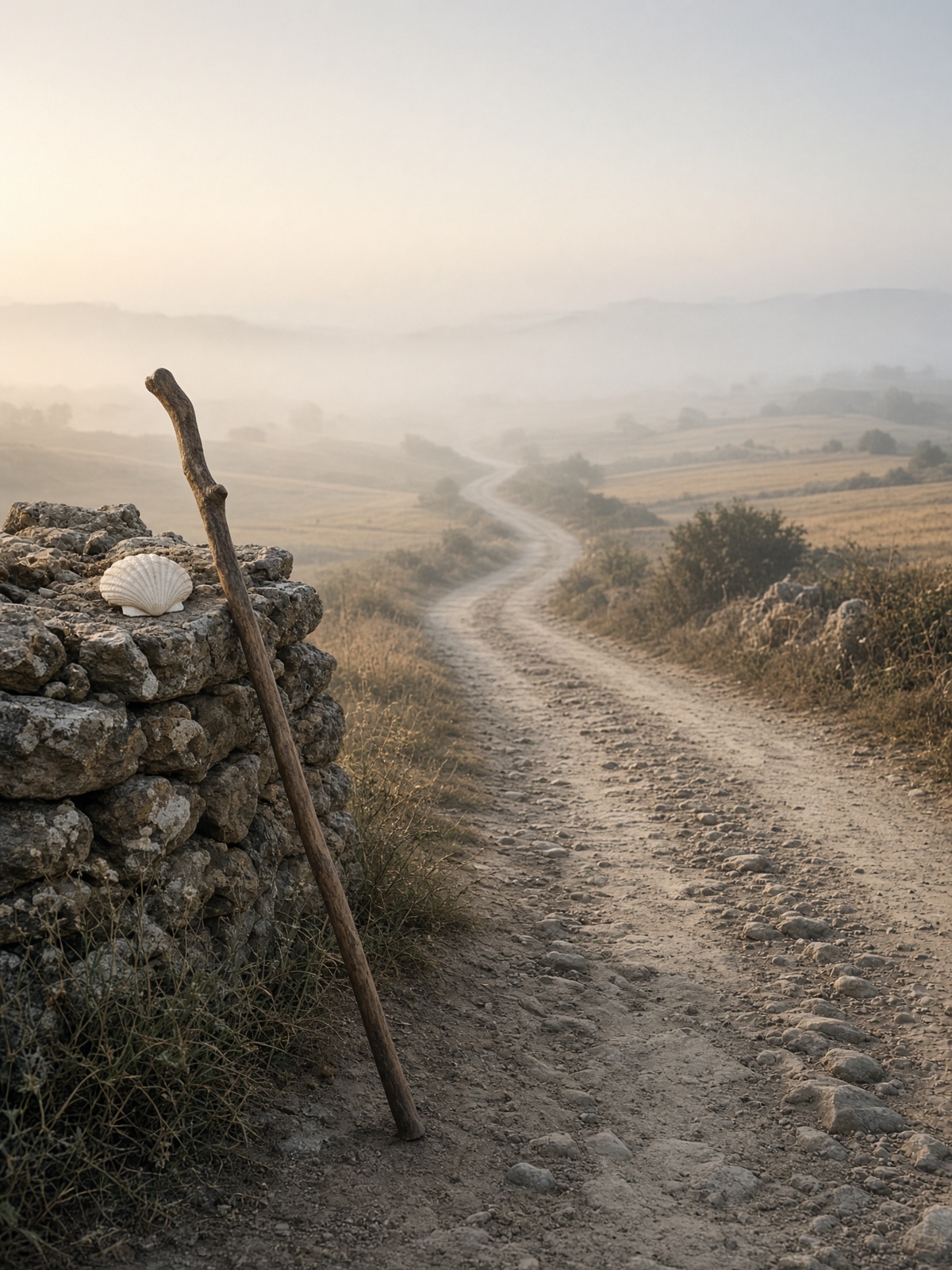
Road
Still walked.
Living road
Not one hero
This is a living practice. Catholics, other Christians, and people of no church walk it now. Medieval pilgrims walked it with different theology, danger, and legal status. Do not flatten those walkers into one hero, and do not treat a shrine as a stage in someone else’s diagram.
Tradition
A tomb, a network, a credential
Destination
A shrine
Medieval Western Europe developed a pilgrimage to the shrine of Saint James at Compostela in Galicia. The historical presence of the apostle’s body is a matter of cult and critique, not a fact to rubber-stamp. What is historical is the road-system: hospitals, indulgences, the Codex Calixtinus, scallop badges, and a legal identity of pilgrim.
Return
A shell, a parish
The object carried back was often a scallop shell, proof, souvenir, amulet, later a tourist mark. Destination and return had different offices: one was arrival at a tomb and a mass; the other was re-entry into a parish with a story and a badge.
Some continued to Finisterre, ‘the end of the land.’ That extra west is not in every medieval itinerary. Do not universalize a contemporary hiking extension into the essence of the cult.
The way
A network, not a single line
French ways, the meseta, Compostela. Finisterre is a later west. A walker’s GPS is not the medieval road.
Roncesvalles
TraditionalA high pass and hospital on one French way. Not every pilgrim entered here.
The meseta
CertainThe Castilian plateau is real weather. Any one itinerary across it is a walker’s, not the cult’s essence.
Santiago de Compostela
CertainThe shrine city. The apostle’s body is cult and critique. The cathedral and the credential are historical offices.
Finisterre
TraditionalCape and later extension. Not required by every medieval itinerary.
A line drawn from the Pyrenees to Galicia is a claim about a network. It is not a reconstructed footstep of one hero.
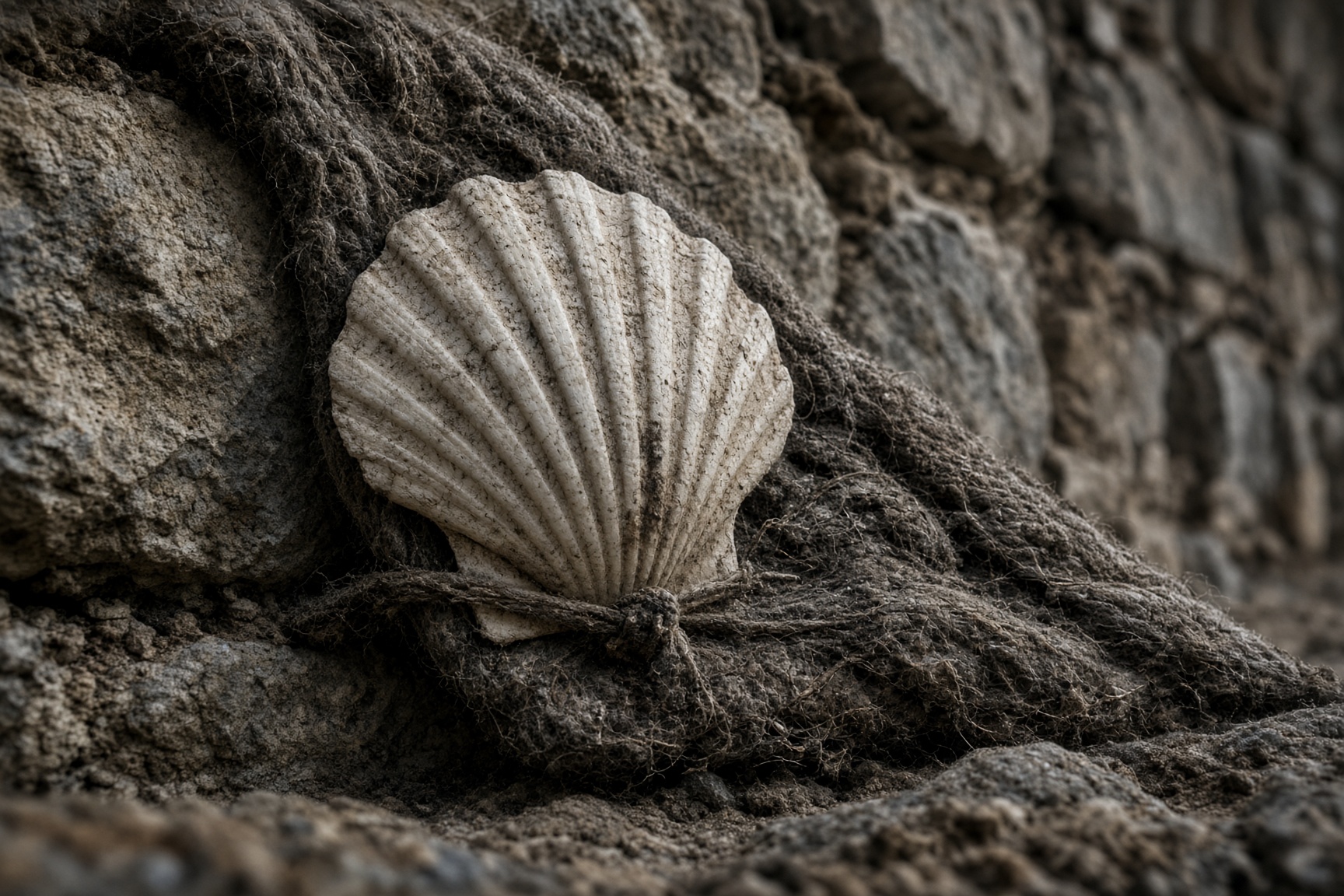
Scallop
Proof, souvenir, amulet
The scallop marked a person as a pilgrim: on the way, at the shrine, and in the parish afterward. Destination and return used the same shell for different offices.
A contemporary walker may still sew one on a pack. That living use does not make the Camino a twelve-stage wheel.
Now
A road that can be many roads
Modern walkers may be devout, athletic, grieving, retired, or collecting a certificate (the compostela) for kilometers walked. All of those are real. None of them make the Camino a twelve-stage monomyth with albergues.
If pilgrimage sits among journey shapes, it is to say: destination and return are not the same act. Going toward a shrine is not leaving a battle. Coming home with a shell is not coming home in disguise to slaughter suitors.
Theory · last
Pattern later
Victor Turner wrote on pilgrimage and communitas; his work is a tool, not a priest. Van Gennep’s rites of passage were drawn from other materials. Use them, if at all, after the road. Do not baptize the Camino as ‘the hero’s journey of Europe.’
Sources
Source text
Liber Sancti Jacobi (Codex Calixtinus), 12th century.
Modern scholarship
Turner, Victor, and Edith Turner. Image and Pilgrimage in Christian Culture. Columbia, 1978.
Anthropology of pilgrimage; not a Camino guidebook.
Verified in the collection
Relationships already established. Not an invitation to add more because they seem plausible.
Motifs
- The Road
A road still maintained.
- The Object Carried Back
The scallop.
Words
- LimenLater critical term
- PilgrimageHistorical context
- QuestionLater critical term
Objects
- The ScallopLatin Christian pilgrimage
Related roads
The word
PilgrimageA return whose office is different
The OdysseyThe shell carried back
Scallop
pilgrimage · pilgrimage