Kur
From the great above she set her mind to the great below.
Above
A goddess goes down dressed as a goddess
Regalia
She does not go as a pilgrim
The Sumerian poem we call Inanna’s Descent is not a Greek katabasis and not a Campbell stage. It is a Mesopotamian narrative, known from cuneiform tablets, in which Inanna, queen of heaven, turns her ear toward the underworld, the realm of her sister Ereshkigal.
She goes in full office. She takes the seven me. ETCSL dressing: a turban, headgear for the open country; a wig; small lapis-lazuli beads at the neck (na₄ za-gin₃ di₄-di₄-la₂); twin egg-shaped beads at the breast, not called lapis; the pala dress, garment of ladyship; named mascara; the pectoral “Come, man, come”; a golden ring; and in her hand a one-nindan measuring reed and a measuring line, of lapis (gi-diš-nindan eš₂-gana₂ za-gin₃). Two lapis objects, not a mood. Kramer’s English often says crown of the steppe for the šugurra. That is another translation, not another tablet.
Instruction
If I do not return
Before leaving she instructs Ninshubur, her minister: if I do not return, raise a lament, go to the gods, do not let me remain below.
That instruction matters. Descent, here, is prepared as a political and ritual risk, not as an accident of wandering.
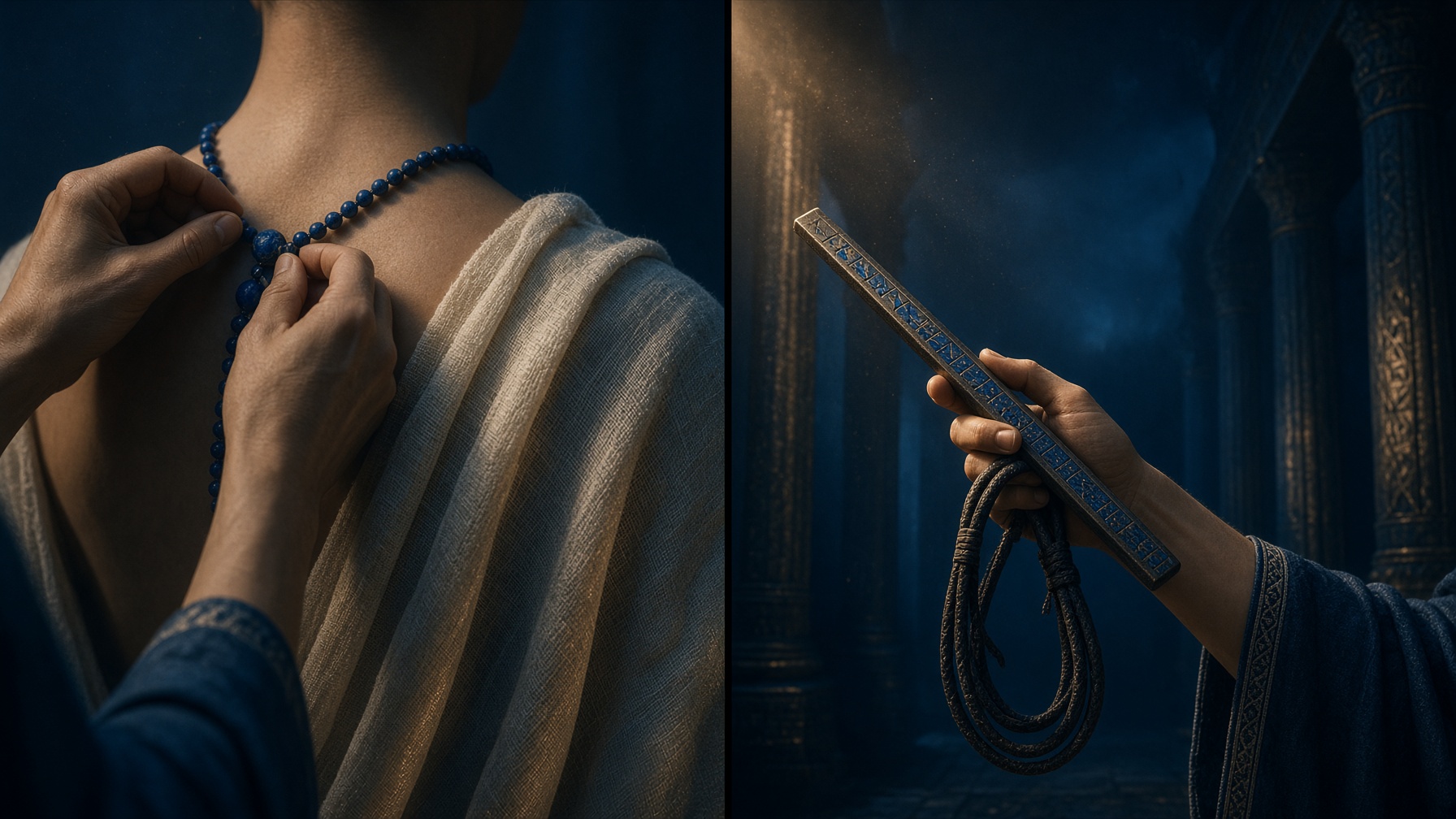
Worn, and held
Two lapis objects. Not a mood.
Geography
A city that can be pointed to. A below that cannot.
Uruk is earth. Kur is plot. The seven gates are the poem’s architecture, not a tourist stair.
Uruk
CertainInanna’s city. Archaeological Uruk in southern Iraq. The poem’s above is a known world of temple and office.
Eridu
CertainEnki’s city. Archaeological Eridu in southern Iraq. In the poem Ninshubur enters the house of Enki after Enlil and Nanna refuse. The city can be pointed to. The rescue is the plot.
Kur, the nether world
Mythic / unlocatableEreshkigal’s realm. Reached by turning the ear below. Not a cave on a map.
The seven gates
Mythic / unlocatableA sequence of unmaking. Do not excavate seven doors and call the story proven.
Mediterranean habit wants a chart. This road is vertical. Certain and mythic can sit on the same page if they are labeled as such.
Seven
Each gate takes a thing
01
First gate
The turban, headgear for the open country, is removed from her head. One manuscript adds two lines here: the one-nindan reed and measuring line taken at the first gate. The composite keeps that removal for the sixth. It is not all witnesses.
02
Second
The small lapis-lazuli beads are removed from her neck. Worn, then taken.
03
Third
The twin egg-shaped beads are removed from her breast.
04
Fourth
The pectoral called “Come, man, come” is removed from her breast.
05
Fifth
The golden ring is removed from her hand.
06
Sixth
The one-nindan measuring reed and the measuring line, of lapis, leave her hand. Held, then taken. A surveyor’s kit, not a second jewel. Whether this is the rod-and-ring of the stelae is argued, not settled. Neti: a me of the kur has been fulfilled.
07
Seventh
The pala dress, the garment of ladyship. She enters naked to the eye of the underworld.
The poem is exact about objects. Lapis is worn at the throat, held as a kit of measure, and taken at named gates. Katz: the undressing is the netherworld’s own ordinance. Power is worn. To pass a threshold is to be unmade as a public being. This is not a metaphor applied afterward. It is the plot.
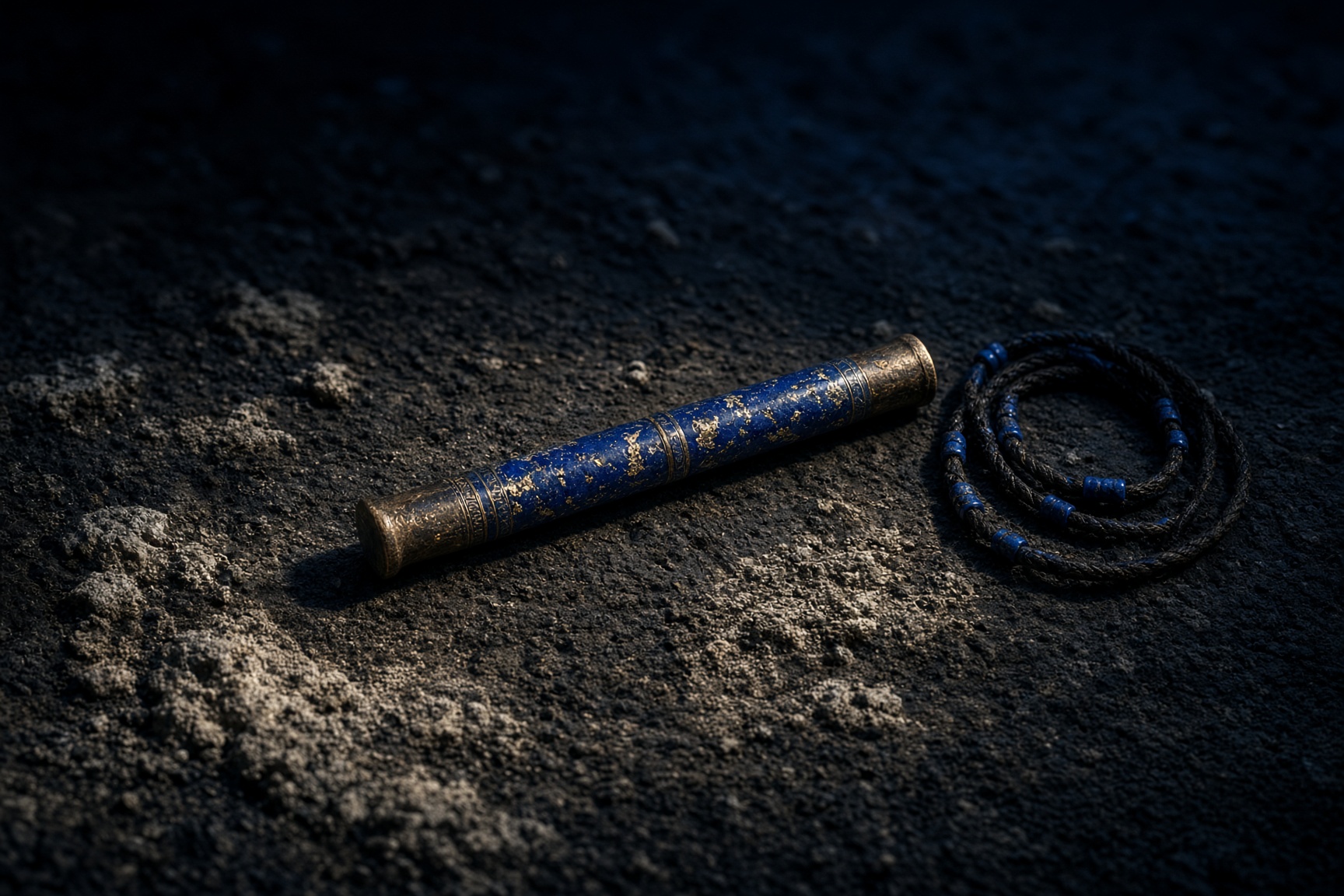
Sixth gate
The lapis kit of measure leaves the hand
A nindan is a length. The reed is the straight. The line is the stretch. Whether this is the rod-and-ring of the stelae is argued, not settled. In the composite it leaves at the sixth gate. One witness takes it at the first.
When she entered the sixth gate, the lapis-lazuli measuring reed and measuring line were removed from her hand.
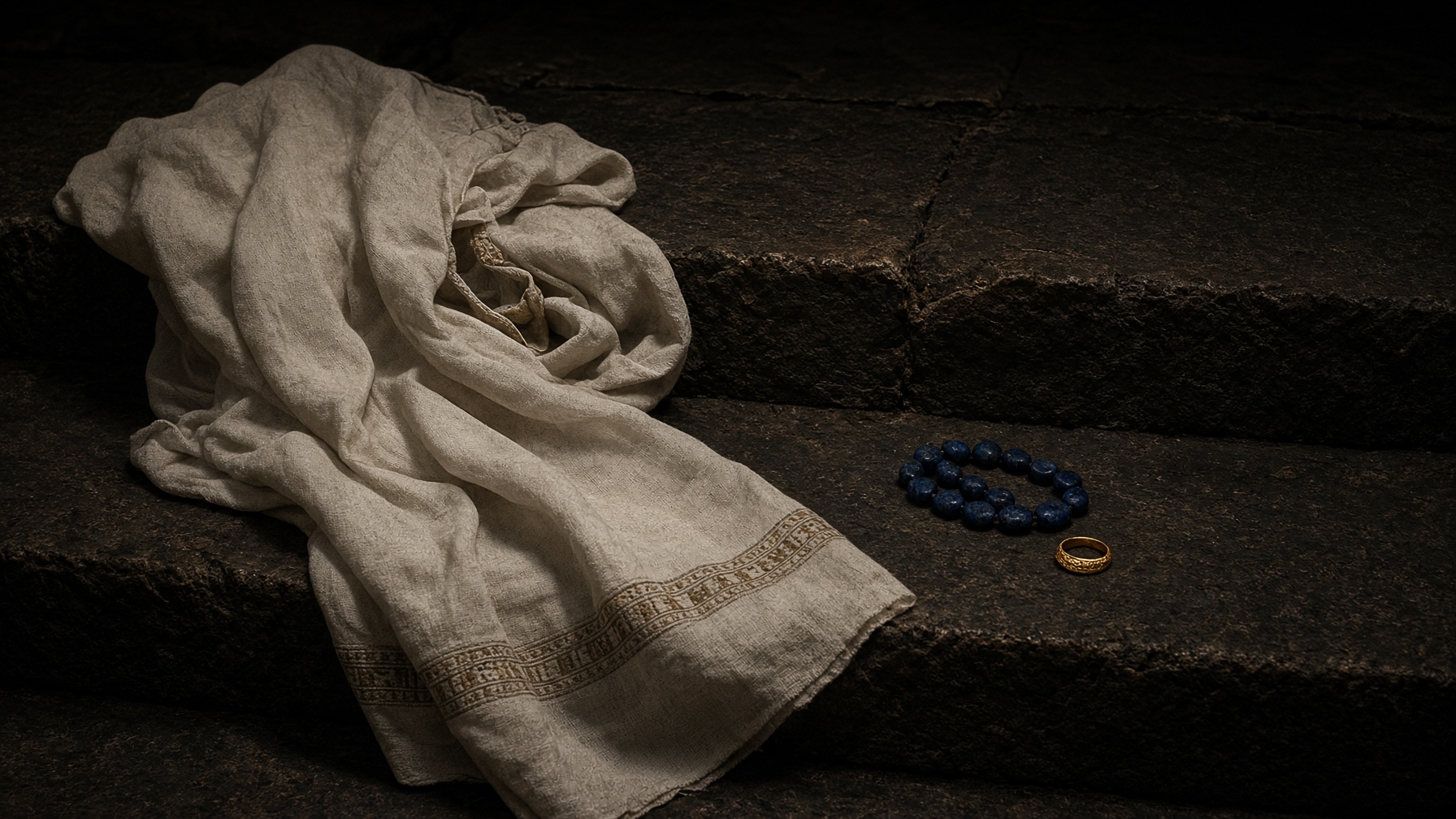
Pala dress
The last thing taken
Crown, rod and line, beads, pectoral, ring, pala. The poem names what is taken at each gate. The last garment is the office of being a goddess in public. Lapis is already gone from the throat at the second gate, and from the hand at the sixth, before the pala is taken.
The list is the tablet’s. A picture of a dress is not the dress.
She enters naked to the eye of the underworld.
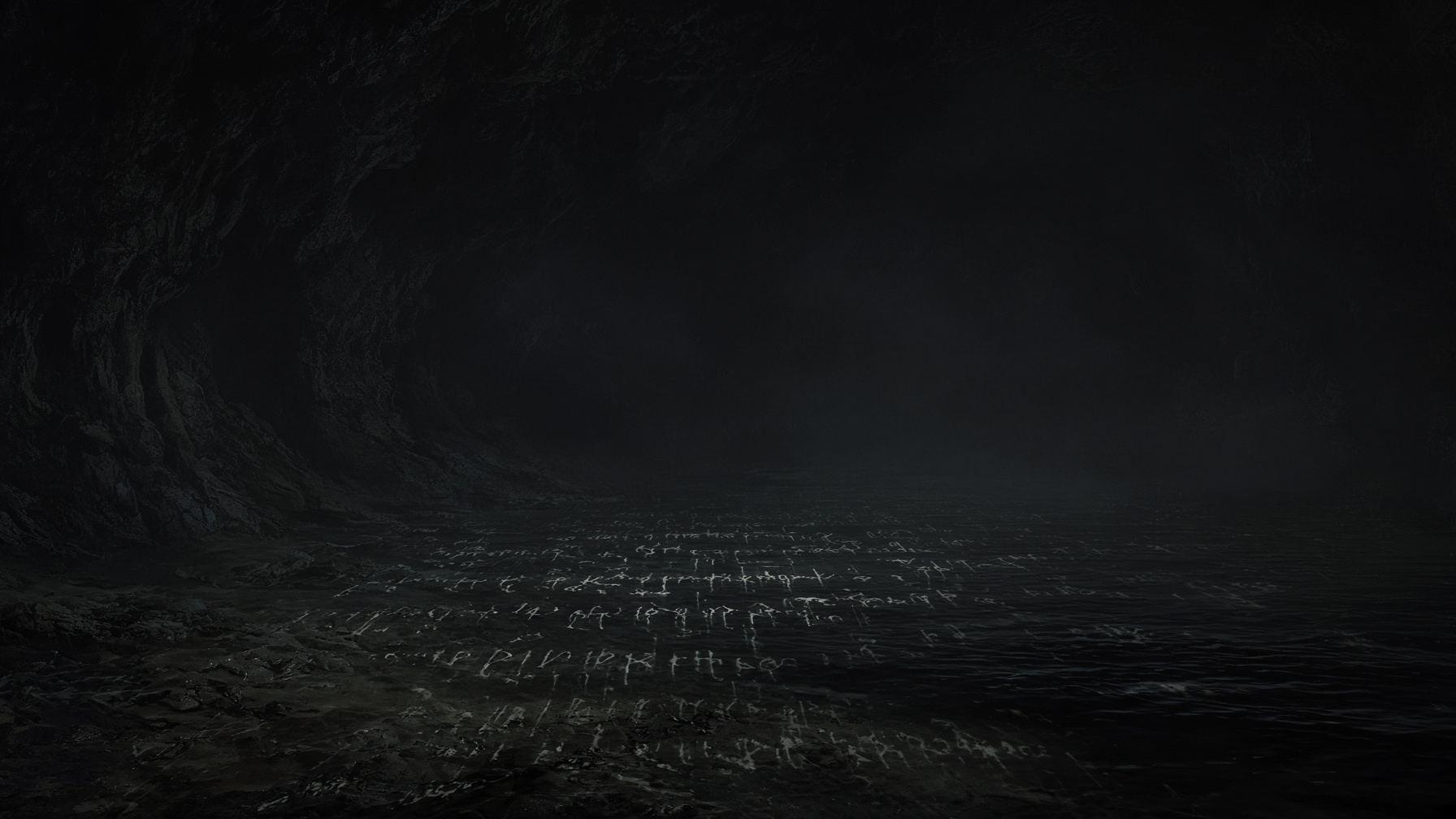
Below
Ereshkigal’s eyes
Sympathy is the key that is not a sword.
Ereshkigal
Queen of the dead. Not a devil, not a workshop shadow. She rules a realm Inanna has entered without remaining a guest. She groans as if in labor.
Inanna
The look of death is fastened on her. She is turned into a corpse and hung on a hook.
The seven judges
They fasten the look. Office below is a court, not a metaphor for the psyche.
Three days and three nights. Ninshubur does as instructed. Before Enlil, then Nanna, then Enki at Eridu she recites the same plea: do not let your precious metal be alloyed with the dirt of the underworld; do not let your good lapis (za-gin₃ sag₉-ga-zu) be split with the mason’s stone; do not let your boxwood be chopped with the carpenter’s wood; do not let young lady Inana be killed in the underworld. A triad of valuables, then the woman. The tablet does not say she is lapis. It says she must not be broken as lapis is broken. Enlil and Nanna refuse. Enki acts.
They sympathize with Ereshkigal. That sympathy is the key that is not a sword. Inanna is sprinkled back into life.
Generated interpretation, not a historical record. Below. Not a devil. A sister’s realm.
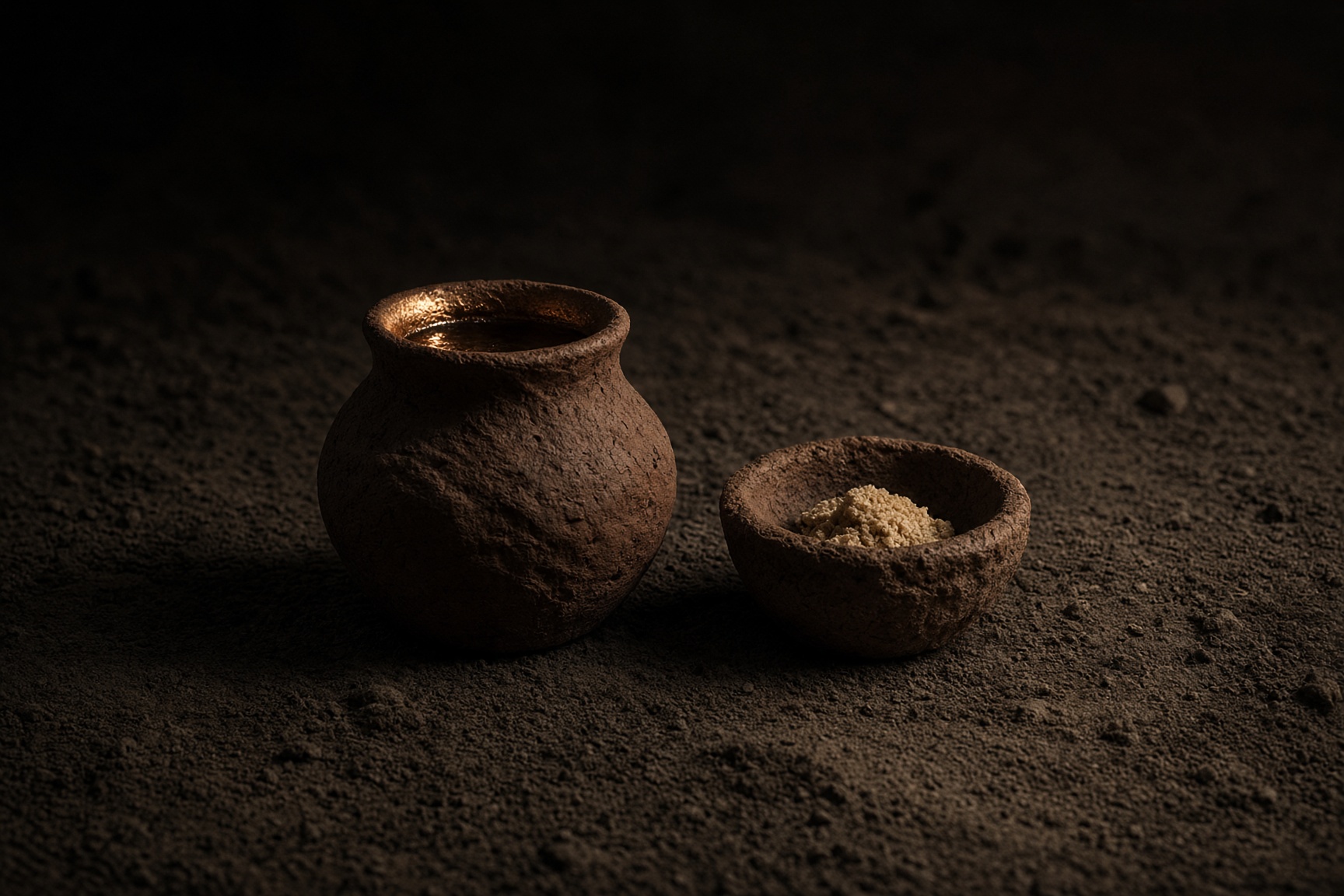
Food and water of life
Two small vessels, not a sword
Enki, worried, takes dirt from his fingernail and makes two small beings. He sends them below with the food and water of life. They do not fight Ereshkigal. They groan with her as if in labor. Sympathy opens what force would not.
The object that returns Inanna is modest. The cost of that return is not.
Return
No one comes back for nothing
Not given
Those who waited
The galla, demons of the underworld, escort Inanna upward. Someone must be given in her place. She will not give them Ninshubur, who waited. She will not give those who mourned her.
Taken
Dumuzi, then a sister’s share
She finds Dumuzi, her husband, seated in fine clothes, not apparently in mourning. He is taken. Geshtinanna, his sister, shares the fate: half the year below, half above.
The agricultural year, in later reading, is often laid over this. The poem itself is first a story about substitution, loyalty, and the unpaid debt of a returned life.
Inanna returns. The world above receives a goddess who has been a corpse. The world below keeps a rotating prisoner. Descent, in this telling, redistributes suffering; it does not cancel it.
Source
Tablets, not a single holy book
The text is Sumerian, with an Akkadian relative (the Descent of Ishtar) that is not identical. Modern readers meet it through composite editions and translations: Kramer, Wolkstein and Kramer, Black and the ETCSL, and others. A popular retelling is not the tablet.
Inanna is a figure of a living scholarly field and of later neopagan reception. Those are different offices. Sacred use by contemporary practitioners is not ours to conscript as proof of a universal heroine.
Reception
Enheduanna, two kinds of forty-two
The corpus
Forty-two temple hymns
Enheduanna, high priestess of Nanna at Ur, is named in a Sumerian temple-hymn corpus later counted as forty-two hymns (Sjöberg, TCS 3). That count is a list, like Numbers 33. It is not a pin on Inanna’s seven gates. Hymns first.
The English spelling
ENHEDUANNA is not Sumerian arithmetic
The name in English letters, spaces and hyphens stripped, is ENHEDUANNA. Full Reduction lands on forty-two. The other three frozen faces do not. The smash is a later spelling. Cipher of that spelling follows. A miss is drawn as carefully as a hit.
INANNA itself does not lock twenty-four or forty-two on these four faces. The wink, if noticed, is the priestess-poet’s later spelling and the hymn-count, not the goddess’s English name. File both. Do not let either become the constitution of the descent.
Cipher
ENHEDUANNA
Four faces. English letters only. Spaces and hyphens ignored.
ENHEDUANNA
English Ordinal
E 5 N 14 H 8 E 5 D 4 U 21 A 1 N 14 N 14 A 1
87
ENHEDUANNA
Reverse Ordinal
E 22 N 13 H 19 E 22 D 23 U 6 A 26 N 13 N 13 A 26
183
ENHEDUANNA
Full Reduction
E 5 N 5 H 8 E 5 D 4 U 3 A 1 N 5 N 5 A 1
42
ENHEDUANNA
Reverse Reduction
E 4 N 4 H 1 E 4 D 5 U 6 A 8 N 4 N 4 A 8
48
Full Reduction forty-two. English Ordinal eighty-seven. Reverse Ordinal one hundred eighty-three. Reverse Reduction forty-eight. One face locks. Three do not.
Forty-two is an invitation. En-hedu-anna means high priestess, ornament of heaven: an office, not a private self. What must a first named poet be, if hymn-count and later spelling agree without the tablets knowing? Cipher is not Sumerian. ISHTAR is noticed, not plated.
Theory · last
Pattern later
A seven-gated stripping will remind some readers of initiation. Van Gennep’s separation / limen / incorporation can be laid beside it without claiming Sumerian authors were illustrating a French anthropologist. Campbell’s monomyth will try to own this story. The substitution of Dumuzi, the laboring of Ereshkigal, and the unpaid cost of return are not a ‘boon brought back to the ordinary world’ in his sense.
The pattern is a lens. The tablet is the road.
Verified in the collection
Relationships already established. Not an invitation to add more because they seem plausible.
Motifs
- The Threshold
Seven gates, seven removals.
- The Return
Return with a substitute demanded.
- The Guide
Ninshubur, Enki’s creatures.
Words
- KatabasisHistorical context
- EnheduannaHistorical context
- InannaIn the source text
- IshtarHistorical context
- QuestionLater critical term
Objects
- The Measuring ReedSumerian
- The Pala DressSumerian
- Food and Water of LifeSumerian
Frameworks
- Joseph CampbellNot applicable
- Arnold van GennepDifferent level of analysis
Related roads
High priestess, ornament of heaven
EnheduannaAnother descent
OrpheusThe kit of measure
One-nindan reedThe last garment
Pala dressWhat returns her
Food and water of life
descent · descent