8 CE
He left Rome. Rome did not take him back.
Carmen et error
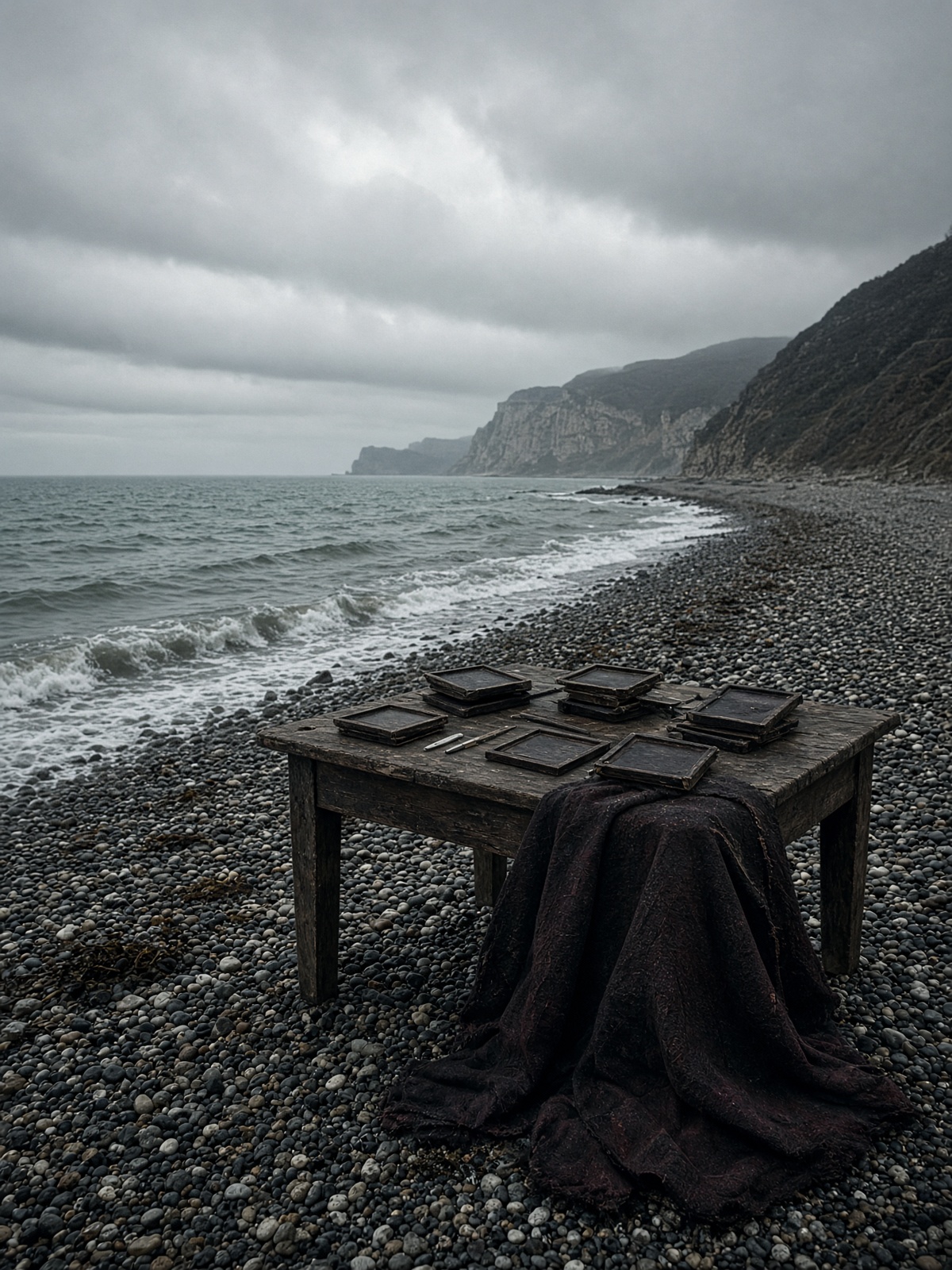
Publius Ovidius Naso, author of the Metamorphoses and the Art of Love, was relegated by Augustus in 8 CE to Tomis, a Greek town on the Black Sea in what is now Constanța, Romania. He was not imprisoned. He was placed at the edge of the Roman world and told to remain.
He says the cause was a poem and a mistake, carmen et error. The poem is likely the Ars Amatoria; the mistake has never been securely identified. Do not pretend to have solved a puzzle Augustus meant to keep dark.
He writes the Tristia and the Epistulae ex Ponto: letters, laments, flattery, winter, language trouble, fear of raids, the social death of being unread in the capital. He dies at Tomis around 17 or 18 CE. There is no nostos.
Shape
A line that does not curve home
If the Odyssey is a problem of recognition at home, Ovid’s exile is a problem of home continuing as a scene you can only address on paper. Friends may still walk the Forum. The books may still circulate. The body is elsewhere.
He claims, sometimes, that the local language is entering his Latin. Whether or not that is true, the image is exact: exile as a slow rewriting of the tongue.
Do not turn this into a spiritual initiation. It is an imperial punishment. The poems are art made from a sentence that did not expire.
Source
Poems as evidence, with caution
Almost everything we know of the exile comes from Ovid. That is a source problem. Archaeology at Tomis can describe a city; it cannot confirm every winter in the Tristia. Read the poems as poems that also want a recall that never comes.
Theory · last
Pattern later
Exile is not a failed hero’s journey. It is a different office: departure without a sanctioned return, identity without a threshold that reopens. Campbell’s circle would falsify the life. This road stays unclosed on purpose.
Verified in the collection
Relationships already established. Not an invitation to add more because they seem plausible.
Motifs
- The Return
No return.
- The Home
Rome as a letter’s address.
Related roads
The return this life does not have
The OdysseyA myth he told, a geometry of not coming back whole
OrpheusThe word
Exile
exile · exile